真正的大,为什么反而要居下
大国者下流,天下之交,天下之牝。
牝常以静胜牡,以静为下。
故大国以下小国,则取小国;小国以下大国,则取大国。
故或下以取,或下而取。
大国不过欲兼畜人,小国不过欲入事人。
夫两者各得其所欲,故大者宜为下。
A great state should be like the lower reaches of a river: the meeting place of all under heaven, taking the receptive and yielding position. The receptive overcomes the assertive through stillness and by placing itself below. Thus, when a great state lowers itself before a small state, it wins the small state’s allegiance; when a small state lowers itself before a great state, it gains the great state’s acceptance. Each obtains what it seeks—and therefore the greater should take the lower place.
江海居大,而处下
王弼解释开头一句时写道:“江海居大而处下,则百川流之。”江海之所以成为江海,不是因为它站得最高,而是因为它处在最低的地方,所以不同来路的水都能汇入其中。
Commenting on the opening line, Wang Bi wrote: “The rivers and seas are great yet dwell below; therefore the hundred streams flow into them.” The sea becomes the sea not by standing above everything else, but by occupying the lowest place, where waters from every direction can gather.
“下流”在这里不是今天的贬义词,而是江河的下游。老子把自然地势翻译成政治原则:越大的国家,越没有必要时时把力量差异摆到别人面前;真正的“大”,本来就意味着更大的容纳能力。
Here, “lower reaches” carries none of its modern derogatory meaning; it simply refers to where rivers descend. Laozi turns geography into a political principle: the greater a state is, the less it needs to display its advantage at every moment. True greatness already implies a greater capacity to accommodate others.
江海不争一水之高,故能成其大。
The rivers and seas do not contend for the highest place; that is why they can become great.
双方都要谦下,但大者更应先下
大国应当像江海一样居于天下的下游,成为四方汇聚之处,并保持柔静谦下。大国愿意谦下对待小国,便能得到小国的归附;小国愿意谦下对待大国,也能得到大国的接纳。
A great state should be like the rivers and seas at the world’s lower reaches: a place where all directions meet, gentle, still, and humble. When a great state treats a small one with humility, it gains the smaller state’s allegiance; when a small state approaches a great one humbly, it gains the greater state’s acceptance.
所以,有的是以谦下取得归附,有的是因谦下而被接纳。大国希望容纳更多的人,小国希望进入一个更大的秩序;若双方都得到所求,那么力量更充足的一方,更应该主动居下。
Some gain allegiance by lowering themselves; others are accepted because they lower themselves. A great state wishes to encompass more people, while a small state wishes to enter a larger order. If both can obtain what they seek, then the side with greater power should be the first to take the lower position.
“牝”“牡”是老子借阴阳语言表达柔静与躁进,不宜直接当成现代男女本质的判断。这里真正的对照是:吸引与强迫、承载与凌驾、静胜与力夺。
Laozi uses the yin–yang language of female and male to contrast receptive stillness with restless assertion; it should not be read as a modern claim about the essential nature of women and men. The real contrasts here are attraction and coercion, support and domination, quiet influence and forceful seizure.
从百川归海,到万国愿来


“取”不是只有夺取,也可以是归附
如果把“取小国”只读成武力占领,这一章会与“以下小国”互相冲突。顺着江海与百川的比喻,“取”更接近吸引、聚合和得到归附:不是我伸手把你抓来,而是我创造一个你愿意进入的秩序。
If “winning the small state” is read only as military occupation, it contradicts the instruction to place oneself below it. Following the metaphor of the sea and the hundred streams, “winning” is closer to attracting, gathering, and gaining allegiance: I do not reach out and seize you; I create an order you choose to enter.
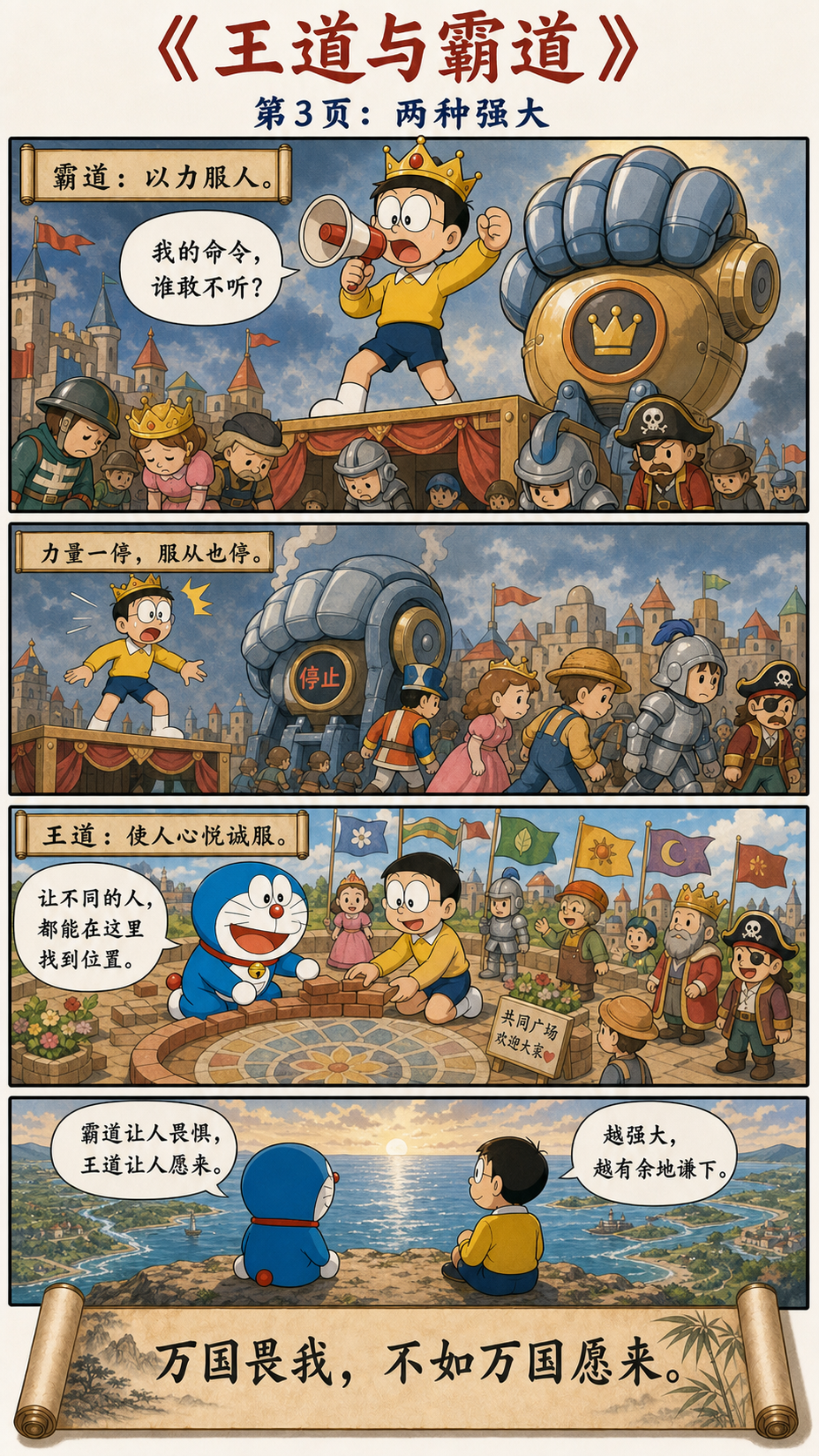
低一级的强大,是让对方不得不服从;更高一级的强大,是让对方判断:留在这里,比离开更安全、更有尊严,也更有机会。
A lesser form of strength leaves others no choice but to obey. A higher form allows them to conclude that staying is safer, more dignified, and more promising than leaving.
小国也要下,为什么最后只提醒大国
老子没有说小国可以傲慢。他明确说“大国以下小国”“小国以下大国”,双方都要放低姿态。区别在于:小国的谦下常常出于生存,大国的谦下才真正体现选择。
Laozi does not grant small states a license to be arrogant. He says clearly that both great and small states should lower themselves. The difference is that a small state’s humility often comes from necessity, whereas a great state’s humility is a genuine choice.
力量越大,越有能力承担不对称的宽容。已经拥有一百的人,不必为了拿走别人最后的二十来证明自己强大。因此结尾不是“大者宜为威”,也不是“大者宜为强”,而是“大者宜为下”。
The greater one’s power, the more able one is to practice an unequal generosity. Someone who already possesses a hundred need not take another person’s last twenty merely to prove strength. The chapter therefore concludes not that the greater should be fearsome or forceful, but that the greater should take the lower place.
与其立刻征服,不如先让关系重新流动
秦亡以后,赵佗在岭南建立南越。汉初经历长期战争,并没有立刻南征。《史记·南越列传》记载,汉十一年派陆贾立赵佗为南越王,剖符通使,希望“和集百越”,避免南方继续成为战争边界。
After the fall of Qin, Zhao Tuo established Nanyue in Lingnan. Exhausted by years of war, the early Han did not immediately launch a southern campaign. According to the Records of the Grand Historian, in the eleventh year of Han, Lu Jia was sent to invest Zhao Tuo as King of Nanyue, restore diplomatic exchange, and bring peace among the peoples of the south.
这不是现代意义上的平等外交,陆贾的说辞中也有鲜明的汉朝权威。但它仍展示了一种成本更低的选择:汉不急于把南越立刻改造成郡县,南越则进入汉朝的名义秩序。双方先恢复使节、贸易与边境稳定。
This was not diplomacy between equals in the modern sense, and Lu Jia’s rhetoric plainly asserted Han authority. Yet it still demonstrated a less costly choice: Han did not rush to turn Nanyue into commanderies and counties, while Nanyue entered the Han order in name. Envoys, trade, and border stability were restored first.
强大到能够容纳不同的人
唐朝当然依靠过战争和扩张,不能把它简单美化成纯粹的柔弱政治。但盛唐长安成为欧亚人员、商品、宗教与艺术汇聚之处,也说明一个强大秩序的另一面:它不只是向外伸展,还能把外来的差异吸收进自身。
The Tang dynasty certainly relied on warfare and expansion; it should not be romanticized as a purely gentle politics. Yet the way Chang’an became a meeting place for Eurasian peoples, goods, religions, and arts reveals another side of a powerful order: it not only extends outward but can also absorb differences from beyond its borders.
粟特商人、突厥贵族、外国使节与佛教僧侣共同出现在唐代生活中。朝贡也常伴随回赐、贸易与文化交换。此时的“大”,不只是疆域和军队,也是让不同来路的人能够在体系内找到位置。
Sogdian merchants, Turkic nobles, foreign envoys, and Buddhist monks all took part in Tang life. Tribute missions were often accompanied by imperial gifts, trade, and cultural exchange. Here, greatness meant more than territory and armies; it also meant enabling people of different origins to find a place within the system.
天下之交,不是天下变得一样;而是不同的人,可以在这里相遇。
A meeting place for all under heaven does not make everyone the same; it allows different people to meet within it.
能取天下,不等于能容天下
若用老子的尺度回看秦朝,最值得区分的是“胜天下”与“天下归之”。秦最擅长用战争体制取得天下,却在统一后继续维持高强度动员、徭役、工程与严密控制。
Viewed through Laozi’s measure, the crucial distinction in Qin history is between conquering the realm and having the realm willingly return to one’s order. Qin excelled at winning the empire through a machinery of war, yet after unification it continued intensive mobilization, forced labor, monumental projects, and strict control.
秦二世而亡当然有复杂原因,不能由一句经典代替历史解释。但老子的追问仍然锋利:你可以用力量把人按下去,却不能由此证明人已经愿意留在你的秩序里。
Qin’s collapse after only two reigns had complex causes; a single classical saying cannot replace historical explanation. But Laozi’s question remains incisive: force may press people down, yet it cannot prove that they wish to remain within your order.
强硬谈判可能有效,但老子还会追问下一局
如果以第六十一章为尺,特朗普的外交风格更接近把力量差异直接兑换成谈判利益:要求盟国增加投入,以关税和市场准入作为交换条件,让不对称的实力变得明确可见。
Measured against Chapter 61, Donald Trump’s diplomatic style more often converts disparities of power directly into bargaining gains: pressing allies to spend more, using tariffs and market access as leverage, and making asymmetries of strength explicitly visible.
这种做法在短期并非无效。北约成员在2025年海牙峰会上承诺,到2035年把核心防务及相关安全支出合计提高到国内生产总值的5%;白宫则明确把这一结果归因于特朗普的施压。2025年的美国关税政策也把税率调整与双边协议、伙伴承诺连接起来。
This approach is not necessarily ineffective in the short term. At the 2025 Hague Summit, NATO members committed to raise combined core defense and defense-related security spending to 5 percent of GDP by 2035; the White House explicitly credited Trump’s pressure for the result. U.S. tariff policy in 2025 likewise tied rate adjustments to bilateral agreements and partner commitments.
但“施压取得了承诺”是事实的一层,“这种方法是否让联盟更长久”是另一层,后者仍需要时间检验。老子关心的不是这一局能否让别人答应,而是对方答应以后,会更愿意靠近你,还是开始寻找下一次不再被拿捏的办法。
But obtaining commitments through pressure is one question; whether that method makes an alliance more durable is another, and only time can answer it. Laozi would ask not merely whether others agree this time, but whether agreement draws them closer—or sends them searching for a way to avoid being pressured next time.
服从解决这一局,归附决定下一局。
Obedience settles this round; allegiance shapes the next.
一个使人畏惧,一个使人心悦
孟子说,凭借力量、借仁义之名使人屈服,是霸;以德行仁,使人诚心归服,是王。老子讲“处下”,孟子讲“行仁”,道路不同,却在一个地方相遇:真正长久的秩序,不能只靠外部强迫。
Mencius says that compelling submission through power while borrowing the name of benevolence is hegemony; practicing humane rule through virtue and winning sincere allegiance is kingly rule. Laozi speaks of taking the lower place, while Mencius speaks of benevolence. Their paths differ, yet meet at one point: no enduring order can rest on external compulsion alone.
老子不是要求大国放弃力量,而是提醒:力量最成熟的用法,未必是把每一分优势都兑现成对方的损失。越强大,越有余地谦下;越能谦下,越可能成为天下汇聚之处。
Laozi does not ask a great state to abandon power. He reminds us that the most mature use of power is not necessarily to convert every advantage into someone else’s loss. The stronger one is, the more room one has for humility; the more one can take the lower place, the more likely one is to become a gathering place for all.
海纳百川,不是因为海会命令河流
海从来不去山顶抢水。它只是处下,给每条河保留自己的来路,最后百川全部进入其中。“有容乃大”的关键,不是把周围变得越来越像自己,而是让自己的秩序有足够大的容量。
The sea never climbs a mountain to seize its water. It simply remains below, allowing each river to keep its own course until all streams finally enter it. The heart of greatness through inclusion is not making everything around you resemble yourself, but giving your order enough capacity to hold difference.
真正高级的强大,不是万国畏我,
而是万国愿来。
The highest form of strength is not to be feared by all nations, but to be a place they willingly approach.